The medicine is the same, the system around it is not: anyone living with a congenital vascular malformation in Switzerland deals with different insurers, different authorities and different rules than people affected in Germany. This article explains what that means in practice and how much really does work differently.
The German Federal Association for Congenital Vascular Malformations (Bundesverband Angeborene Gefässfehlbildungen e.V.) has been doing outstanding work for years and has more than 500 members. It supported us with advice and experience while we were being founded, and some patients are members of both associations to this day. So why has there been a separate Swiss Angiodysplasia Association since January 2025? The answer lies in everyday life after the diagnosis. Anyone who needs cost approval for compression stockings, is preparing an application to the Disability Insurance (IV) or is planning treatment abroad needs to know how the Swiss system works.
Working with our German partner associations has made it clear how important it is to show why and where the two healthcare systems differ so markedly. This article is therefore also explicitly addressed to readers in Germany, our northern neighbour.
The following sections show where the two countries differ significantly for those affected.
Health Insurance: Chronically Ill People Pay the Maximum Every Year
In Switzerland, people with chronic illnesses bear their full share of costs every year; there is no relief comparable to the German rule for the chronically ill.
Cost sharing. In basic health insurance, adults first pay the deductible (at least 300 francs), then a 10 percent co-payment up to a maximum of 700 francs. Anyone in regular treatment therefore reaches at least 1,000 francs year after year, plus 15 francs per day in hospital (Helsana). In March 2026 the Federal Council proposed raising the minimum deductible to 400 francs (FOPH). In Germany, co-payments are 10 percent, at most 10 euros, and are capped at 1 percent of gross income for people with serious chronic illnesses (betanet).
Premiums. Swiss premiums are flat per-person premiums, independent of income and charged separately for each family member. The only relief is the cantonal premium reduction, with 26 different sets of rules.
Off-label medicines. Many treatments for vascular malformations are off-label. In Switzerland, the individual health insurer decides on request under Art. 71a–71d of the Health Insurance Ordinance (KVV). An evaluation commissioned by the Federal Office of Public Health (FOPH) found approval rates of between 46 and 74 percent depending on the insurer; the same model case was assessed differently by 16 insurers (final report 2020). Which insurer you have can therefore help decide whether you get access to a treatment.
Repeat prescriptions. For medicines needed long term, Switzerland is practical. Doctors can prescribe a long-term treatment for up to one year, and the pharmacy dispenses it repeatedly during that time. With the patient’s consent, the pharmacy may even continue a long-term treatment prescribed by a doctor until the next doctor’s appointment, for a maximum of one year (pharmaSuisse). Germany has only had the multiple-dispensing prescription since April 2023, and only as an e-prescription: at most four dispensings within one year. Doctors are not obliged to issue it, and the costs can weigh on their budget (KVWL).
Supplementary insurance. Supplementary hospital insurance is governed by private law. Insurers may accept applications with a reservation for pre-existing conditions or reject them, which regularly affects people with congenital malformations.
Aids and Therapies: Stockings Cost More, Physiotherapy Is Easy to Access
People affected in Switzerland are worse off when it comes to compression stockings, but Switzerland does well on access to physiotherapy and lymphatic drainage.
Compression stockings in Switzerland. Basic insurance reimburses at most two pairs per year, and only up to the maximum amount set in the list of reimbursable aids and appliances (MiGeL). Made-to-measure stockings fall under a separate tariff and, according to the Price Supervisor, cost five to eight times as much as off-the-shelf stockings. Stockings bought abroad are not reimbursed, even though they are around 20 percent cheaper in Germany (Price Supervisor, 2017). On top of that comes cost sharing: anyone who has not yet reached their deductible pays for the stockings themselves.
Compression stockings in Germany. The health insurer covers one pair per prescription and, if needed, a second pair to change into; a new supply is possible after six months. Contract suppliers must offer a supply without extra costs, and the co-payment is at most 10 euros (Barmer).
Physiotherapy and lymphatic drainage in Switzerland. A doctor’s prescription is valid for nine sessions. Four series, i.e. 36 sessions, are possible without approval; only after that is a report to the insurer’s medical adviser required (physioswiss). For most of those affected, this access works well in everyday life.
Physiotherapy and lymphatic drainage in Germany. Here, the guideline on therapeutic services (Heilmittel-Richtlinie) determines what may be prescribed and for how long. Manual lymphatic drainage from lymphoedema stage II counts as a long-term need and does not burden the prescribing doctor’s budget; stage I or prescriptions without a stage remain subject to cost-effectiveness checks (KV Baden-Württemberg). Whether a vascular malformation is classified this way therefore depends heavily on the diagnosis code. In addition, there is a 10 percent co-payment plus 10 euros per prescription.
Invalidity Instead of Disability: Switzerland Has No Severe Disability Card
Germany assesses how severely a person is impaired. Switzerland mainly asks how much they can still earn.
Germany: degree of disability. The responsible authority sets a degree of disability (Grad der Behinderung, GdB). From a GdB of 50, a person is considered severely disabled and receives a card (DRV). This comes with compensatory benefits, including for people who work full time: additional leave, special protection against dismissal, earlier retirement and tax allowances.
Switzerland: invalidity as loss of earnings. There is no comparable status. The Disability Insurance (IV) measures the inability to earn and follows the principle of “integration before pension”. A pension is only paid from a degree of invalidity of 40 percent, a full pension from 70 percent, and at the earliest after a waiting year with an average incapacity for work of 40 percent (AHV/IV). Anyone who keeps working despite pain, swelling and frequent medical appointments therefore has no recognised status and no compensatory benefits.
Congenital disorders: a break at 20. Congenital vascular malformations are on the list of congenital disorders, for example under numbers 312 (lymphatic malformations), 313 (congenital vascular malformations requiring treatment) and 482 (phakomatoses such as Sturge-Weber) (GgV-EDI). However, the IV only pays for treatment until the patient turns 20; after that, the health insurer is responsible (FSIO). Young adults thus switch to a different system in the middle of a lifelong condition, with a deductible, co-payments and new cost approvals. Germany has no such break.
Work and Financial Security: Less Protection, More Personal Responsibility
At work, people affected in Switzerland are far less protected, and financial security during illness depends heavily on the employer.
Protection against dismissal. In Germany, dismissing a severely disabled employee after six months of employment requires the prior consent of the Integration Office (Integrationsamt) (Arbeitskammer). Switzerland has no special protection for people with disabilities. Only those who are currently unable to work are protected, and only for a limited time: 30 days in the first year of service, 90 days in the second to fifth, 180 days from the sixth (Pro Infirmis).
Notice periods. In Switzerland, the statutory notice period from the tenth year of service (SECO) is only three months. In Germany, the employer’s notice period grows with length of service, reaching seven months to the end of the month after 20 years (§ 622 BGB). Anyone with a chronic illness who has to look for a new job therefore has much less time in Switzerland.
Income during illness. In Germany, six weeks of continued pay are followed by statutory sickness benefit. In Switzerland, daily sickness allowance insurance is voluntary and is usually taken out through the employer. Private insurers offering daily allowances may exclude pre-existing conditions indefinitely and do not have to accept anyone (FOPH). For people with a congenital condition, every change of job is therefore a risk.
Earlier retirement. Severely disabled people in Germany with 35 years of insurance can retire without deductions from 65, or from 62 with a deduction of at most 10.8 percent (DRV). Switzerland has no such old-age pension. Anyone who has to stop working early depends on an IV pension, supplemented by the invalidity benefits of their pension fund and, where applicable, supplementary benefits.
Hospitals: Short Distances, but a Network Still Being Built
Switzerland has a real advantage: specialised centres can be reached from almost anywhere within one to two hours. Regular check-ups at a centre are therefore realistic even for adults, who in Germany often have to travel long distances.
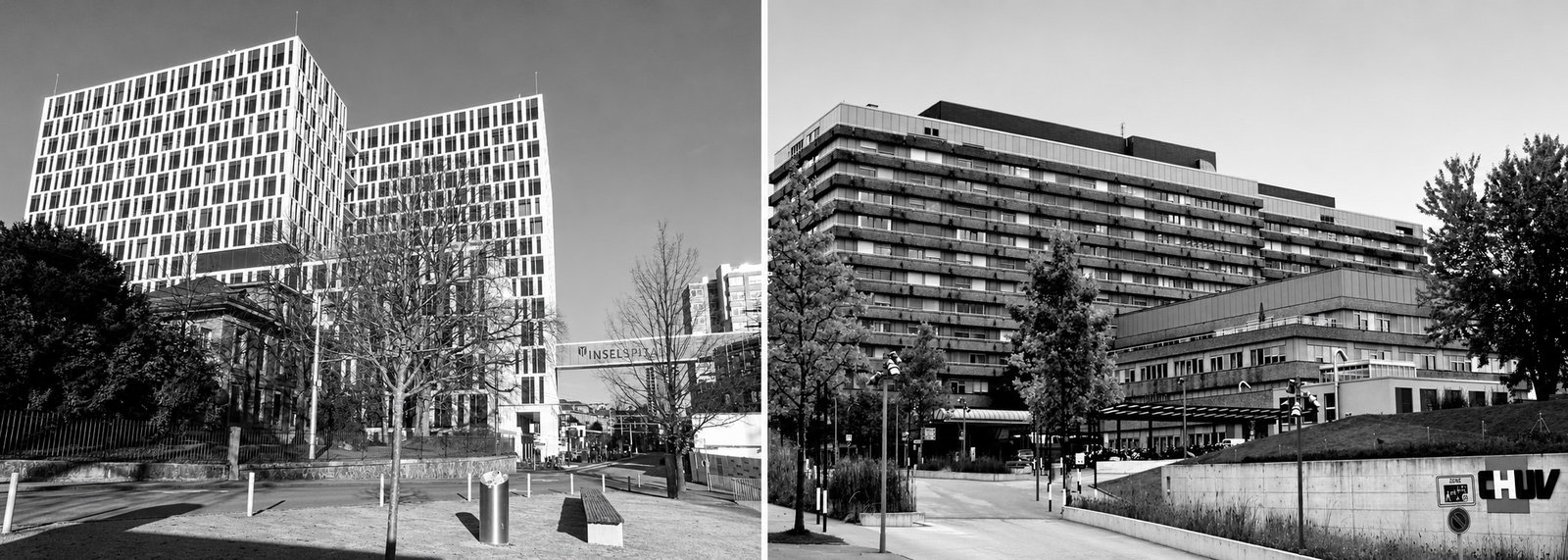


Two centres are particularly important for adults affected:
- Bern: The Competence Centre for Vascular Malformations at the Inselspital’s University Vascular Centre discusses cases of children and adults in an interdisciplinary meeting every week. Specialists from more than 20 disciplines offer diagnostics, genetic counselling, surgery and laser, endovascular and drug therapies (Inselspital).
- Lausanne: The Centre des malformations et maladies vasculaires rares (CMVR) at the CHUV was recognised in 2026 as the Swiss reference centre for rare vascular diseases and also accepts patients without a confirmed diagnosis (CHUV).
Children: The University Children’s Hospital Zurich is particularly important for the care of children and adolescents. Its Vascular Anomalies Board Zürich (VABZ) brings together plastic surgery, dermatology, interventional radiology and specialised nursing advice. It offers weekly consultations and regular case conferences, which external specialists can also attend (University Children’s Hospital Zurich). Basel also works with Zurich on paediatric surgery (USB).
Other university and cantonal hospitals also treat vascular anomalies. In Basel, a joint board of the University Hospital and the Children’s Hospital discusses cases of children and adults every two weeks and works with Zurich (USB). The Geneva University Hospitals were also recognised in 2026 as a reference centre for rare vascular diseases (HUG).
Swiss VASC-RN. With the Swiss VASC-RN reference network, coordinated by Prof. Lucia Mazzolai at the CHUV, a national structure for vascular diseases is being created for the first time (angiodysplasie.ch). For those affected, however, it is still hard to see who treats which form of malformation and how the centres work together. This is where we want to help, just as DiGGefa connects specialists and centres in Germany.
Cantonal hospital planning. Each canton keeps its own hospital list. Free choice of hospital applies throughout Switzerland, but at a hospital outside one’s own canton, a cost difference may arise without medical grounds, to be paid by supplementary insurance or by the patient.
Treatment Abroad: A Route with a High Cost Risk
Swiss policyholders have hardly any entitlement to planned treatment abroad, whereas people insured in Germany can receive outpatient treatment in Switzerland without prior approval.
Territoriality principle. Basic insurance only pays for planned treatment abroad if there is no treatment option at all in Switzerland or if treatment here carries significantly higher risks. The Federal Supreme Court interprets this narrowly: greater experience or higher case numbers at a foreign clinic are not enough on their own (Federal Supreme Court 9C_264/2018).
A particular problem with rare diseases. In a small country, even specialised centres see only a few cases of a particular malformation. Sometimes treatment in a neighbouring country makes medical sense, but whether the costs will be covered is unclear. Anyone who travels without cost approval bears the risk themselves.
Unequal rights across the border. Thanks to the agreement between Switzerland and the EU, people with statutory insurance in Germany can receive outpatient treatment in Switzerland without prior approval, and inpatient treatment with approval (betanet). Conversely, Swiss policyholders are covered by the Health Insurance Act (KVG) alone. As a non-EU country, Switzerland does not benefit from EU patients’ rights in cross-border healthcare.
Federalism and Multilingualism: 26 Cantons, Four Languages
Swiss health policy is even more federal than German health policy. What is handled uniformly in Germany through statutory health insurance is often regulated here by each canton itself.
Kantönligeist. Hospital planning, premium reductions and the IV offices are organised at cantonal level; the Swiss call this cantonal parochialism “Kantönligeist”. Two people with the same diagnosis can therefore have different experiences depending on where they live. An association that knows and collects these differences can give targeted advice.
Screening. Whether, and from what age, screening examinations are paid for by the health insurer also varies from canton to canton. Bowel and breast cancer screenings are exempt from the deductible only in cantonal programmes; not all cantons run such programmes, and the age groups differ (Swiss Cancer League).
Four languages. Patients and specialists are spread across German-speaking Switzerland, French-speaking Switzerland and Ticino. Information from the German federal association hardly reaches the French- and Italian-speaking parts of Switzerland. We therefore run our website in German, French, Italian and English and attend events in several language regions, such as Rare Disease Day 2026 in Bellinzona. Connecting patients and experts across the language borders nevertheless remains a task of its own.
Funding: Self-Help without Public Money
In Germany, health insurers are required by law to help fund self-help; in Switzerland, there is no public funding for patient organisations.
Germany. Under § 20h of the Fifth Book of the Social Code (SGB V), statutory health insurers fund self-help groups, self-help organisations and contact points with 1.36 euros per insured person (as of 2025), more than 101 million euros a year in total (AOK). Associations active nationwide receive lump-sum and project funding (vdek).
Switzerland. There is no comparable funding. Patient organisations like ours depend on membership fees, donations and volunteer work.
What could change. The Federal Council is planning a Federal Act on Measures to Combat Rare Diseases (BSKG); the dispatch to Parliament is due by spring 2027. It provides for financial aid for information and advisory activities, explicitly to strengthen patient organisations. However, this is an optional provision, and the Confederation only pays if the cantons contribute the same amount (FOPH).
The Differences at a Glance
| Topic | Switzerland | Germany |
|---|---|---|
| Cost sharing | Deductible from CHF 300 plus 10 % up to CHF 700 a year, no relief for the chronically ill | 10 % co-payment, at most €10; capped at 1 % of income for the chronically ill |
| Premiums | Flat premium per person, cantonal reduction | Income-related contribution, family insurance |
| Off-label medicines | Request to one’s own insurer, practice varies by insurer | Case-by-case decision by the health insurer |
| Long-term medication | Repeat prescription for up to 1 year, pharmacy dispenses repeatedly | Multiple-dispensing prescription only as e-prescription, at most 4 dispensings a year, doctors not obliged |
| Compression stockings | At most 2 pairs a year up to the maximum amount, only if bought in Switzerland; counts towards the deductible | 1 pair per prescription plus a change pair if needed, new after 6 months; at most €10 co-payment |
| Physiotherapy, lymphatic drainage | 9 sessions per prescription, 36 without approval | Heilmittel-Richtlinie; lymphatic drainage from stage II exempt from cost-effectiveness checks |
| Disability status | No card; the IV measures loss of earnings | Degree of disability, severe disability card from GdB 50 |
| Congenital condition | IV pays for treatment up to 20, then the health insurer | Statutory health insurance throughout |
| Protection against dismissal | Only protection periods during incapacity for work, 30 to 180 days; notice period at most 3 months | Consent of the Integration Office required; notice period up to 7 months |
| Income during illness | Daily allowance insurance voluntary, reservations for pre-existing conditions possible | 6 weeks of continued pay, then sickness benefit |
| Earlier retirement | No special old-age pension; IV pension from a 40 % degree of invalidity | Old-age pension for severely disabled people from 62 with a deduction |
| Treatment abroad | Only if no treatment is possible in Switzerland | Outpatient care in the EU and Switzerland without approval |
| Distance to a centre | Short; national Swiss VASC-RN network being built | Specialist clinic often far away |
| Organisation | 26 cantons, four national languages | Uniform national health insurance, one language |
| Screening | Exempt from the deductible only in cantonal programmes, not in all cantons | Uniform national programmes |
| Funding of self-help | No public money; financial aid planned in the proposed BSKG | Statutory funding by health insurers, €1.36 per insured person (2025) |
Conclusion: Independent in Switzerland, Connected across the Border
People affected in Switzerland need their own association because almost every question after the diagnosis requires a Swiss answer: from the deductible to the IV to cost approval for treatment abroad.
This does not replace our cooperation with the German federal association; it complements it. We are happy to share medical knowledge, training and gatherings such as AngioCon across the border. The work on the Swiss framework, on connecting the centres in Swiss VASC-RN and on building links across four language regions is something we do here.
We started with three people in January 2025. Since then the association has grown steadily and now has 15 members.
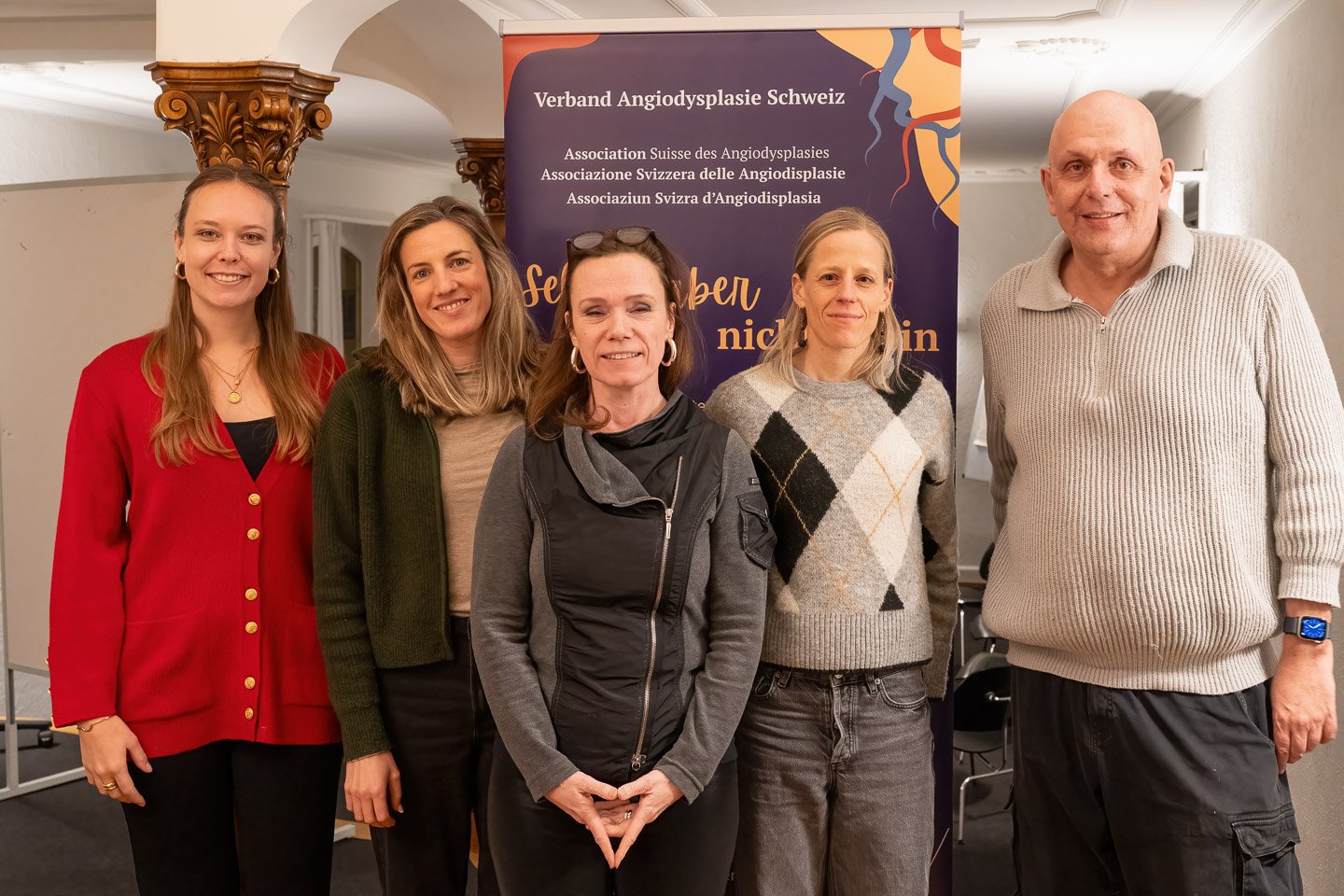
“Rare, but not alone”: this is as true in Germany as it is in Switzerland.
Sources
Most sources are in German.
- Helsana: Cost sharing
- FOPH: Adjustment of the deductible, March 2026
- betanet: Exemption from co-payments for the chronically ill
- koordination.ch: MiGeL
- FOPH: Evaluation of Art. 71a–71d KVV, final report 2020
- koordination.ch: GgV-EDI with list of congenital disorders
- FSIO: Congenital disorders
- AHV/IV: Invalidity pensions
- German Pension Insurance (DRV): Earlier old-age pension with a severe disability
- Arbeitskammer des Saarlandes: Severely disabled people at work
- Pro Infirmis: Termination of employment
- FOPH: Voluntary daily allowance insurance
- University Hospital Basel: Reference centre
- HUG: Seven centres recognised as reference centres
- Federal Supreme Court, judgment 9C_264/2018
- betanet: Treatment abroad
- AOK: Self-help funding, legal basis
- vdek: Self-help funding by statutory health insurance
- FOPH: Legislation on rare diseases
- Price Supervisor: Medical compression stockings, 2017
- Barmer: Compression therapy
- physioswiss: Frequently asked questions on prescribing physiotherapy
- KV Baden-Württemberg: Prescribing manual lymphatic drainage from October 2024
- Swiss Cancer League: Early detection
- SECO: FAQ on dismissal
- § 622 BGB: Notice periods for employment relationships
- pharmaSuisse: Medical prescriptions
- KVWL: Multiple-dispensing prescription
- Inselspital Bern: Competence Centre for Vascular Malformations
- CHUV: National reference centre for rare vascular diseases
- University Children’s Hospital Zurich: Dermatology and Vascular Anomalies Board Zürich
- Swiss Angiodysplasia Association: Swiss VASC-RN – an important step and a big task