What a new database on rare diseases reveals – and why patients still have to bridge the gaps between medical specialties.
Talk: “Launching an open-access database of clinical recommendations and practice guidelines for rare heritable connective tissue disorders” – Poster #32
Speaker: Catherine Isadora Coté, Université de Montréal (Canada)
Session: Poster Pitches, Day 1, ECRD 2026, Prague
On both conference days of ECRD 2026, a selection of poster authors presented their work in short, sharp pitches. One contribution from the first day has stayed with me in particular: Catherine Isadora Coté of the Université de Montréal presented a project that sounds very specific at first glance – a searchable database of clinical recommendations for rare, heritable connective tissue disorders. On closer inspection, though, she describes a pattern that reaches far beyond her own disease field and, I think, has a lot to say about the care of vascular malformations in Switzerland too.
Coté is a PhD candidate in clinical psychology and lives with a heritable connective tissue disorder herself – her poster project is thus not merely an academic interest, but grounded in lived experience. That also explains why, in a recently published journal article, she addresses a related question: how are researchers treated who themselves live with the condition they study? Together with colleagues from the universities of Laval, Montréal and Trois-Rivières, she examines how “lived experience” in health research is often dismissed as bias, even though it is precisely what reveals blind spots in established research – an idea that reappears directly in her ECRD project: there too, it is the people affected themselves who see what the literature is missing.
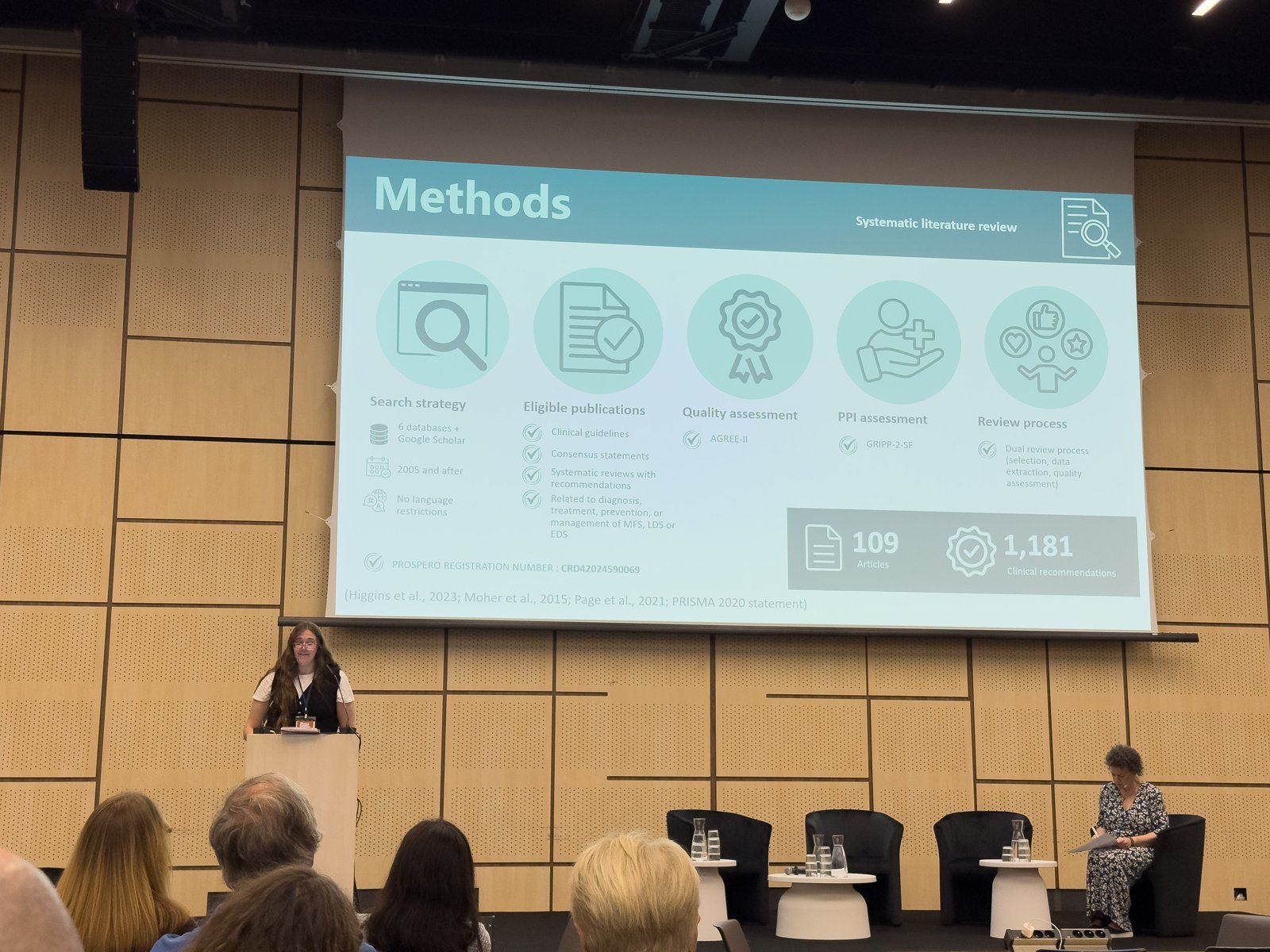
Three conditions, 109 publications, 1,181 recommendations
Coté’s project started from a simple but hard-to-answer question: how do you organise care for conditions that affect practically the entire body? Heritable connective tissue disorders (HCTDs) such as Ehlers-Danlos syndrome, Marfan syndrome and Loeys-Dietz syndrome simultaneously involve the cardiovascular system, the nervous system, the joints and other organs. It is precisely this multi-system nature that makes it difficult to organise care sensibly around individual specialties.
To address this, her team conducted a systematic review of clinical recommendations and guidelines for the three condition groups – with a surprising result: 109 publications containing a total of 1,181 individual clinical recommendations were identified, far more than the team had expected. All of these recommendations were brought together in a publicly accessible, searchable database – filterable by condition, society, genetic variant, clinical domain, symptom, medical specialty or life stage.
Well covered: what is life-threatening
The analysis revealed a clear pattern. Recommendations exist in growing numbers – above all where life-threatening complications are concerned: cardiovascular events, pregnancy risks, diagnosis and genetics. For the rarer, more severe subtypes (such as vascular forms of Ehlers-Danlos syndrome), however, the evidence remained very thin and was almost exclusively limited to diagnosis and genetics.
Barely covered: what shapes everyday life
The picture looked very different for the topics that shape quality of life day to day: mental health, social support, rehabilitation (physiotherapy and occupational therapy), and interdisciplinary care coordination. According to Coté, these areas remained “strikingly underrepresented”. On top of that, even where recommendations do exist, they are scattered across hundreds of publications and professional societies – hard for clinicians to find, and nearly impossible for patients.
Only around 12 per cent of the publications analysed involved patients in developing the recommendations at all – and mostly only by having them read over the finished manuscript, not as equal partners in the development process.
What patients and clinicians report back
In the project’s second step, the team consulted patients, families, professional societies and clinicians about the mapped recommendations. One piece of feedback kept coming back: the model of care implied by the guidelines does not match the lived reality of those affected.
“I have yet to meet a healthcare professional who is knowledgeable about connective tissue disorders beyond pain and joint hypermobility.”
— a patient interviewed for the study, reported faithfully from the presentation
Coté offered an image that has stuck with me: patients become the “invisible infrastructure” holding a fragmented system together – carrying information back and forth between specialists themselves, explaining their condition over and over again, coordinating their own appointments, and carrying the emotional burden of that fragmentation on top of it. One side observation is worth noting too: several interviewees reported that simply taking part in the research – being heard and taken seriously – mattered to them in itself, regardless of the actual research outcome.
As a next step, the team is planning a “patient-friendly pathway”: an interactive application linking clinical recommendations with diagnostic knowledge and community resources – developed together with patients, clinicians and patient organisations. In the subsequent Q&A, the audience also raised the obvious question of data protection; Coté clarified that the database exclusively aggregates already-published, public scientific literature and contains no patient-level data whatsoever.
The parallel that struck me: vascular malformations
As a representative of the Swiss Angiodysplasia Association, I listened to this talk with a very concrete sense of recognition. Congenital vascular malformations are, likewise, rare and often multi-systemic conditions – and here too, most research, guidelines and care structures traditionally concentrate on angiological symptoms: classification of the vascular malformation (e.g. under the ISSVA system), diagnostic imaging, embolisation (the targeted occlusion of feeding vessels from the inside, usually via catheter), sclerotherapy (the targeted obliteration of the malformation by injecting an agent that fuses the vessel walls together), and surgical resection (the operative removal of the malformation).
That’s understandable – bleeding, thrombosis or a vascular rupture can be acutely life-threatening, just like an aortic dissection in Marfan or Loeys-Dietz syndrome. But the exact same asymmetry that Coté describes for connective tissue disorders shows up here too: what is well studied and captured in guidelines are the acute, intervention-requiring events. What is far less well documented are chronic pain, reduced mobility, psychosocial burden, and coordination between angiology, dermatology, vascular surgery, pain medicine and – often overlooked – psychology.
A recent review on vascular malformations in children confirms this picture: health-related quality of life is markedly affected by the condition, including psychosocially – and the authors explicitly call for a more holistic, multidisciplinary approach that systematically incorporates psychosocial support and rehabilitation, rather than treating them as an optional add-on. A study on patient-reported outcomes in vascular malformations likewise concludes that psychosocial functioning is noticeably impaired across all age groups – an aspect that has historically received far less weight in the literature than interventional treatment itself.
Where the collaboration works – and where it doesn’t
At vascular malformation centres too, interdisciplinary collaboration is often only partly a lived practice. What is usually well rehearsed is the exchange between angiology and vascular surgery – there are established, shared workflows here, for instance when deciding on embolisation, sclerotherapy or resection. Far less taken for granted is the connection to specialties such as dermatology, neurology, psychology, haematology, pain management and other fields that are just as often affected in many vascular malformations. In practice, this coordination is frequently left to patients themselves.
This is exactly where the real parallel to Coté’s talk lies. She described how patients with connective tissue disorders become an “invisible infrastructure” because coordination between specialties isn’t institutionally anchored, but instead falls on them. The same applies to vascular malformations: a tight, well-functioning core – here, angiology and vascular surgery – doesn’t yet mean that care as a whole is coordinated. It is precisely the specialties that don’t deal with the vascular malformation itself, but with its everyday consequences – skin changes, neurological impairment, coagulation disorders, chronic pain, psychological distress – that easily fall through the cracks.
A positive counterexample already exists here: the OVAMA questionnaire (Outcome measures for VAscular MAlformations) is a scientifically validated instrument that lets patients assess their current symptoms directly themselves – split into general symptoms, head-and-neck-specific symptoms, appearance, and satisfaction with treatment. It was developed specifically because earlier follow-up assessments relied too heavily on clinicians’ judgement and too little on what patients themselves experience as burdensome. This shows that instruments capturing lived experience in a structured way are possible for vascular malformations too – they already exist at individual centres, though they are still far from established everywhere in everyday clinical practice. That said, the same caveat applies here: a symptom being captured and documented does not automatically mean multidisciplinary treatment follows. If a patient reports chronic pain or psychological distress on the questionnaire, for example, a clinician or centre still needs to pick up that feedback and route it to the right place – exactly the coordination work that is often missing day to day. What is also missing from this picture is Coté’s second step: a systematic overview of which specialties and life domains actually have recommendations and care offerings – and which don’t.
What could be transferred from Montréal
What strikes me as particularly valuable about Catherine Coté’s project, then, is not so much the database itself as the method behind it: systematically mapping – together with patients themselves – where recommendations and coordination actually exist, and where they don’t. For vascular malformations, such an approach could reveal just how much of the existing literature and care reality is concentrated on the angiological-vascular-surgical core – and how little on the connection to dermatology, neurology, psychology, haematology or pain management, or on the transition from paediatric to adult care. For a small association like the Swiss Angiodysplasia Association, that would be a tangible starting point: not calling for more interdisciplinarity in general, but naming concretely which specialties actually need to be brought together for patients in practice – and where that isn’t happening yet today.
Conclusion
Two disease groups that look very different at first glance – heritable connective tissue disorders and vascular malformations – reveal the same underlying pattern: as long as research and guidelines are oriented primarily around acute, organ-specific risks, much of what actually occupies patients’ everyday lives remains underserved. And in both cases, it is ultimately patients themselves who bridge that gap – becoming, in Coté’s words, the invisible infrastructure of their own care.
About this report. Written on the basis of the official ECRD 2026 programme and my own audio recording of the Poster Pitch session (Day 1). Quotes are reported faithfully based on the English-language presentation.
Further reading by Catherine Isadora Coté:
Leblanc-Huard G, Coté CI, L’Espérance A, Thériault J (2026): “Toward an inclusive (crip) epistemology: Exploring the experiences of researchers with lived experience of disability in health research”, Health (SAGE), DOI: 10.1177/13634593261455074.
Background sources on vascular malformations:
Congenital Vascular Malformations in Children: From Historical Perspective to a Multidisciplinary Approach in the Modern Era – A Comprehensive Review
Patient-Reported Outcomes and Psychosocial Impact of Vascular Malformations
Lokhorst MM, et al. (2021): Development of a condition-specific patient-reported outcome measure for measuring symptoms and appearance in vascular malformations: the OVAMA questionnaire, British Journal of Dermatology 185(4): 797–806
The assessment of interdisciplinary collaboration at vascular malformation centres is based on my own experience as an association representative.